Properly Identifying Scaffold Types and Foundations Is your scaffold supported? I sure hope so since an unsupported scaffold isn’t much of a scaffold. Can a scaffold be supported but yet not supported? Yes it can but that’s a dumb question. Obviously all scaffolds require support, some from the ground and some from above, such as [...]
Is It Supported?
April 9th, 2013 by David H. Glabe, PE
What is Value Engineering?
March 28th, 2013 by Jared Thompson
What would you do if I made you this offer: give me fifty dollars today, and in return you will get back one hundred dollars tomorrow? This is a no-brainer, right? Who wouldn’t want a 100% return on their investment – not to mention in one day! Unfortunately for all of us, there is no [...]
Scaffold Legs Under Duress
February 28th, 2013 by Donald McCuskey, P.E.
An Introduction to Panel Points and Why They are Important After reviewing many user manuals for scaffold, it is clear that scaffold manufacturers understand the strong and weak locations of each of their respective systems. However, I have not seen any scaffold user or technical manual attempt to explain to their users why they always show [...]
Tricks of the Shoring Trade
February 26th, 2013 by Tracy Dutting-Kane, P.E
How to Ensure Safety While Shoring an Existing Structure Shoring existing structures can be a tricky business. Typically, the older the building is the more complicated the shoring of it can become. Many older structures do not have drawings of the existing construction and if they do, they are not always reliable. Many buildings go [...]
Trust the Math for Your Eyes May be Deceived
February 19th, 2013 by Zachary Forster, P.E.
An inside look at why fall protection anchors must be tested Fall protection! When you put on your harness, tie off to a fall protection system, and step to the edge of the roof on a 20 foot tall building, do you know that you are truly safe? Or is this maybe just a false [...]
General Industry or Construction?
February 4th, 2013 by David H. Glabe, PE
Should the scaffold you just erected in the local oil refinery comply with the US federal Occupational Safety & Health Administration (OSHA) General Industry Standards or the Construction Industry Standards? While you might think this is a question with an easy and simple answer, it isn’t. Does it matter which standards apply? That question has [...]
Is a Mast Climber a Scaffold?
December 17th, 2012 by David H. Glabe, PE
Is a mast-climbing work platform a scaffold? This is a common question due to conflicting information provided by OSHA. The quick answer to the question is yes, but determining the applicability of OSHA standards for mast climbers requires a bit of research, a real understanding of what a mast climber is, and common sense. While [...]
OSHA as Insurance
November 28th, 2012 by David H. Glabe, PE
Insurance is a big deal. There’s life insurance, medical insurance, insurance for insurance (reinsurance) and scaffold insurance, to name a few. Generally, the purpose of insurance is to reduce financial risk for an individual entity; frankly, another way to look at it is that insurance shares the risk with other similar individual entities. For example, [...]
Useful Regulations
November 8th, 2012 by David H. Glabe, PE
While some may believe there are no useful regulations, and certainly the actions of some scaffold users would confirm that belief, the OSHA standards (regulations) governing how we use scaffolds are actually quite, well useful. Included are exciting minimum requirements such as who is to inspect scaffolds and who is to supervise the construction of [...]
The Rise And Fall of Elevators
October 31st, 2012 by David H. Glabe, PE
Moving vertically on a construction project can be a challenge. While stairs are normally available, it doesn’t make a whole lot of sense to use those to climb 50 stories unless you are interested in a lot of exercise! Consequently hoists, elevators and lifts are frequently used to transport workers and materials between the various floors of [...]
Are You Stable?
October 4th, 2012 by David H. Glabe, PE
Tarps and other enclosure materials, such as plastic sheeting, are typical materials used to create a desirable work atmosphere. Many scaffolds are enclosed in screening and debris netting—I recall one resort project in Aruba where the scaffold was wrapped in a mesh to ensure, so I was told, that construction debris would not blow into [...]
Do You Know Suspended Scaffolds?
September 7th, 2012 by David H. Glabe, PE
Are you familiar with suspended scaffolds? Do you know the difference between a suspended scaffold and a hanging scaffold? Well, here’s a chance to show your friends and neighbors how well you know suspended scaffolds. Take this quiz and see if you are the best of the best. The answers are at the bottom of [...]
Federal OSHA 29 CFR 1926.451(c)(2): Foundations and Swivel Jacks Clarification
July 2nd, 2012 by David H. Glabe, PE
A clarification of OSHA Standard 29 CFR 1926.451(c)(2)(i) which requires that: “Footings shall be level, sound, rigid, and capable of supporting the loaded scaffold without settling or displacement.”
Industrial Strength Bracing
May 23rd, 2012 by David H. Glabe, PE
When it comes to scaffold bracing, when is there enough bracing? Certain untrained erectors, and users, assume that if the scaffold isn’t falling down, then there is enough bracing; not a very smart, practical or safe approach. And then there is the question of what type of bracing are you talking about?
OSHA Q & A: Interesting Facts about OSHA
April 25th, 2012 by David H. Glabe, PE
It’s amazing how many people have very little understanding about the US federal Occupational Safety & Health Administration, OSHA, especially since it has been in existence for almost a half century. I suspect there are people who still think it’s a town in Wisconsin! Well, here are some questions, with answers, that might expand, or at least confirm, what you know about OSHA.
How Well Are You Connected?
March 27th, 2012 by David H. Glabe, PE
Connections play a big part in the proper erection of a scaffold. Knowing how connections work, which products to use, and their strengths are important for both erectors and users.
Being well-connected may suggest that you have a strong bond with another person or at least you may have influence over another person’s behavior and action. Unfortunately, this article is not about that type of connection-you’ll have to go somewhere else for advice on being personally well-connected. But what about your scaffold; is your scaffold well connected? And what kind of connections are we talking about?
What is the Foundation for the Foundation?
March 25th, 2012 by David H. Glabe, PE
Identification of the correct safety factors for scaffold foundations.
Will Your Knee-Out Work?
March 1st, 2012 by David H. Glabe, PE
A description of the proper use of a knee-out.
Boards and Rails
February 1st, 2012 by David H. Glabe, PE
A quiz that evaluates your understanding of the correct installation and use of supported scaffold platforms and fall protection.
Bricks and Steel
January 15th, 2012 by David H. Glabe, PE
Masons are allowed to be exposed to fall hazards due to over-hand bricklaying while on steel supported scaffolds; the use of side brackets (knee-outs) with supported scaffolds.
It is difficult to imagine masonry construction without scaffolding. Prior to the advent of steel frame scaffolding, Bricklayer’s Square scaffolding was used to provide an elevated work platform for the masons to conduct their work. Starting in the 1930’s, steel scaffold frames slowly replaced the wood scaffolds commonly used by masons. Adjustable scaffolds, specifically designed for masons, became available in the 1970’s and the evolution continues today with mast climbers and other powered platforms being used by masons…
Thoughts for a New Year
January 1st, 2012 by David H. Glabe, PE
A stimulating and thought provoking discussion addressing safety concerns with scaffolding.
How Do They Fit?
December 1st, 2011 by David H. Glabe, PE
A practical explanation as to the relationship between the OSHA standards, enforcement, compliance and safety in the construction industry.
Is it Okay or Not?
November 1st, 2011 by David H. Glabe, PE
How to determine if the scaffolding you have is in good condition or whether it should be scrapped.
The Wind Sucks
October 1st, 2011 by David H. Glabe, PE
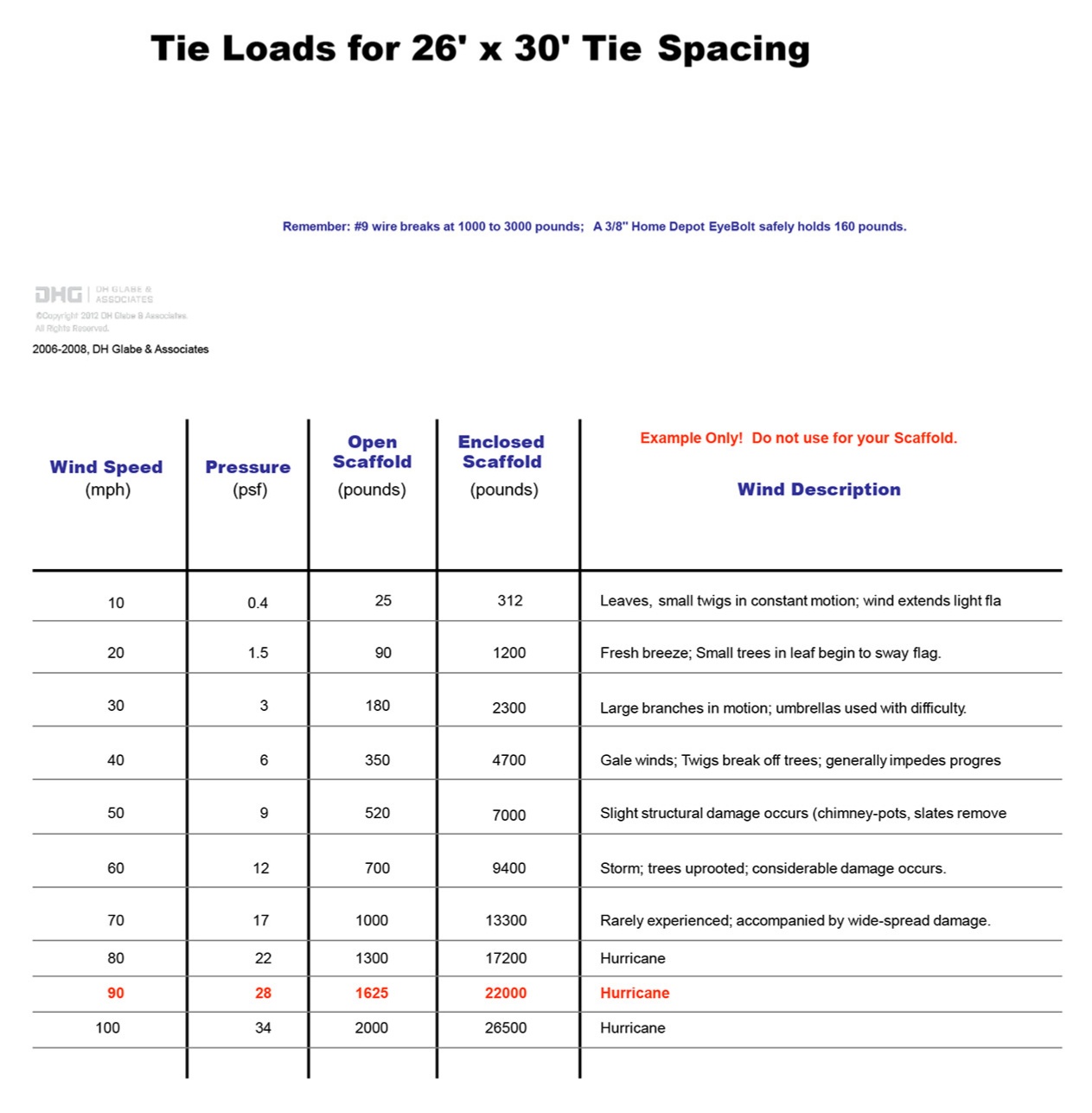
An explanation of the effects that the wind has on a scaffold that is wrapped or enclosed with a tarp, shrink wrap, plastic or other cladding.
Complex Applicability
September 1st, 2011 by David H. Glabe, PE
An appraisal of the codes and standards that apply to aerial lifts, including boom lifts and scissors lifts.
Plank or Platform?
August 1st, 2011 by David H. Glabe, PE
Is it a plank or is it a platform? Can a plank be a platform or can a platform be a plank? When it comes to the working surface for a scaffold, these questions are common. But they shouldn’t be. It appears the confusion arises because the use of wood planks for scaffold platforms is [...]
Are Scaffolds That Dangerous?
July 1st, 2011 by David H. Glabe, PE
A clarification of the role that wood scaffold plank in the construction of a scaffold platform.
Worth Reviewing
June 1st, 2011 by David H. Glabe, PE
An assessment of the OSHA standards that apply to fall protection for scaffolds and scaffold users and erectors.
Where Did The Shoring Go?
May 1st, 2011 by David H. Glabe, PE
An argument for re-establishing the Shoring & Forming Council in the Scaffold and Access Industry Association.
I Know It All!
April 1st, 2011 by David H. Glabe, PE
An April Fools Day sarcasm on scaffold safety, regulations and government control.
Technology? Trends?
March 1st, 2011 by David H. Glabe, PE
Technology’s effect on the future of regulations and training.
The Power of the Beam
February 1st, 2011 by David H. Glabe, PE
The Amazing Inside Story of how a Cantilever Beam Works!
Competent Scaffold User
January 1st, 2011 by David H. Glabe, PE
An explanation of the term “Competent Person” and its relation to scaffold user training and scaffold competent person training.
Industrial Scaffolds – Unique or Common?
December 1st, 2010 by David H. Glabe, PE
Scaffolds used in locations such as refineries, chemical plants and power stations are often referred to as industrial scaffolds, suggesting they are unique to that environment. But are they?
Aerial Lift or Mobile Scaffold?
November 1st, 2010 by David H. Glabe, PE
A debate about the OSHA scaffold standards for construction, which reference an American National Standards Institute, ANSI, standard that does not include scissors lifts. This ANSI standard, known as ANSI A92.2-1969, was written in 1969, before the proliferation of aerial lifts that we have today.
Suspended Scaffold Mysteries
October 1st, 2010 by David H. Glabe, PE
My experience indicates that people easily get confused about suspended scaffolds. I’m not sure why that is other than it may have something to do with their knowledge, or lack thereof, of suspended scaffolds and how they work. This shouldn’t be surprising since most people base their knowledge on what they have seen on the evening news. Here are a few questions and answers that occur about suspended scaffolds.
How Does the Scaffold Hold That Load?
September 1st, 2010 by David H. Glabe, PE
The OSHA standards require a scaffold user to have training. One of the requirements of that training is that the user must know “The maximum intended load and the load carrying capacities of the scaffold used” [29 CFR 1926.454(a)(4)]. Thanks to Swiss physicist Leonhard Euler, (typically pronounced “Oiler”), a method was developed to determine the strength of a column (which is what a scaffold leg is).
Don’t Know, Then Ask
August 1st, 2010 by David H. Glabe, PE
Since scaffolding includes many types of products used in many different applications, it is difficult to address all the specific issues that may develop during the use of scaffolding.
Twisted Confusion
July 1st, 2010 by David H. Glabe, PE
It appears the U.S. Federal Occupational Safety and Health Administration, OSHA, has managed to thoroughly twist a well written scaffold regulation to the point where many scaffold erectors, users and compliance officers will be totally confused. I am referring to a recent Letter of Interpretation that addresses the stability of scaffolds, and more specifically the method for tying a supported scaffold to an adjacent structure so the scaffold doesn’t fall over.
Fact or Fiction
June 1st, 2010 by David H. Glabe, PE
Fall protection is a huge topic these days what with people falling down and falling from heights. And since scaffolds are, by definition “any temporary elevated platform,” the issue of fall protection is significant, especially since most scaffold fatalities are due to falls from heights. It doesn’t have to be this way. Scaffold suppliers have this really cool product called a guardrail that when used properly, will keep you from falling.
Platform or Plank?
May 1st, 2010 by David H. Glabe, PE
Is this a tough question? Is plank a platform or is the platform a plank? Here is a primer on what constitutes a safe scaffold platform. Of course, that begs the question as to whether you can have an unsafe platform. And the answer to that question is pretty easy: yes.
Up and Down – And Around Too!
April 1st, 2010 by David H. Glabe, PE
Mast Climbing Work Platforms are marvelous pieces of equipment. And safe too, provided you behave yourself. Actually it isn’t very difficult to use these platforms—provided you have been trained. That isn’t unusual. After all, if you want to use any scaffold or aerial platform you have to be trained.
Industrial or Commercial?
March 1st, 2010 by David H. Glabe, PE
Is it an industrial scaffold or a commercial scaffold? That is the question that I am regularly asked. And what is the answer? Simply stated, I doubt there is a difference. Now, before you industrial erectors get in a tizzy, there is no doubt that there is a difference in the application of the scaffold and the circumstances and environment where an industrial scaffold is used. However, the physics, engineering, and safety are all the same.
Can You Use This?
February 1st, 2010 by David H. Glabe, PE
The U.S. Occupational Safety and Health Administration, OSHA, included an interesting section in the scaffold standards when they were issued in 1996. It is the section called “Use.” Since it is included in the scaffold standards, I think we can obviously assume it to be the use of scaffolds. Do you know what’s in it? Do you know to whom this section applies? Is it the scaffold “user” or is it perhaps the erector? Well, the snappy answer is: the user. But that doesn’t mean the erector should ignore it. After all, the erector has to make sure the scaffold is constructed correctly so the user can safely use it. So let’s take a fresh look at the section’s content and see how it applies to users of scaffolds.
How Much More?
January 1st, 2010 by David H. Glabe, PE
How much more can we do? Will more standards increase the safety of suspended scaffolds? Will training increase the safety of suspended scaffolds? Will more safety features increase the safety of suspended scaffolds? Wait—is there a problem that needs to be addressed or are suspended scaffolds safe? It is always interesting when I first meet someone and tell them I am involved with scaffolding. Sooner rather than later they tell me how dangerous it all must be and how could I still be alive? And when I tell them that a properly constructed scaffold, including one hanging down the side of a building by ropes is completely safe, they just insist that I must not know what I am talking about.
Random Numbers
November 1st, 2009 by David H. Glabe, PE
One definition for the word random is “without pattern; done, chosen or occurring without an identifiable pattern, plan, system or connection.” Apply that to numbers and you have a set of numbers that have no relationship to each other. In other words, you have a bunch of numbers that don’t mean anything. Apply the random numbers to scaffolding and you still have a bunch of numbers that don’t mean anything. When reviewing the US federal Occupational Safety & Health Administration (OSHA) and other safety standards that apply to construction and more specifically scaffolding, one must wonder if the whole thing isn’t some sort of random number selection.
Hot Wheels
October 1st, 2009 by David H. Glabe, PE
No, this isn’t about the toy cars you played with-it’s about scaffolds with wheels that you work with. Actually we call those wheels casters and we call the scaffolds mobile scaffolds or rolling scaffolds. These masters of mobility come in many shapes and sizes and manufacturers. But one thing is for sure: used correctly they are a great aid to increased productivity, used incorrectly and you are in a world of hurt, literally.
The Standard Standard
September 1st, 2009 by David H. Glabe, PE
Have you ever wondered where safety standards came from? Are you convinced they are there to make your life more difficult? Did someone in ancient history dream them up? Did the Greeks or Romans have scaffold safety standards? Where did the U.S. federal Occupational, Safety and Health , (OSHA) standards come from? Are there other standards or codes for scaffolding?
An Association: What is it?
August 1st, 2009 by David H. Glabe, PE
Since an association is “an organization of persons having a common interest” (Webster’s 7th New Collegiate Dictionary), it can be concluded the Scaffold Industry Association is a group of folks who have an interest in scaffolding. And what a group it is!
Common Sense – Does it Exist?
July 1st, 2009 by David H. Glabe, PE
Common sense, or the lack thereof, appears to be pervasive in society; it certainly is evident in the scaffold industry and construction in general. Webster’s Universal College Dictionary describes common sense as “sound practical judgment that is independent of specialized knowledge or training.” Great definition but what is “sound practical judgment?” Relying on the same reference, judgment is “The ability to judge, make a decision, or form an opinion objectively or wisely, especially in matters affecting action; good sense; discernment.” To carry this one step further, Webster defines sense as “sound practical intelligence.”
We Still Have Rules
June 1st, 2009 by David H. Glabe, PE
Rules, rules, and more rules. Rules are made to be broken. What good are the rules if nobody follows them? Why do I have to follow the rules when my competition doesn’t? The other guy doesn’t follow the rules and he doesn’t get caught; it’s not a level playing field! I’ll follow the rules as soon as everybody else does. The rules don’t make sense. The rules are for somebody else, the guy who doesn’t know what he’s doing. Nobody is happy with rules and it might appear that rules are more of an impediment to safety than an asset.
Congratulations NOT in Order
May 1st, 2009 by David H. Glabe, PE
The scaffold industry has done it again; we are in the OSHA top ten! Before you go out, celebrate and enjoy the accolades, you need to know that it is a “Top Ten” that none of us should be proud of. The Top Ten I am referring to is the annual list of the “Top Ten Construction Violations” compiled by federal OSHA. If nothing else, the scaffold industry is consistent; we are always in the top ten – unfortunately. The bright spot is that we don’t hold the top spot and we don’t hold all ten spots, just half of the top ten.
Here are the top ten:
The Bovinean Slop Hypothesis
April 1st, 2009 by David H. Glabe, PE
The what? The Bovinean Slop Hypothesis. It’s a concept that I have formulated based on an incredible foundation of research in this exciting area of human behavior. While I have limited my research to the construction industry, I suspect, and there is some profound data supporting this suspicion, that this hypothesis is applicable to other disciplines, including the financial market, politics, and transportation, to name a few. But I digress.
What Responsibility?
March 1st, 2009 by David H. Glabe, PE
Everybody knows that jobsite safety is everybody’s responsibility. Or at least that is what everybody says. But is it really true? Does everybody really think that it is everybody’s responsibility to be responsible? Besides, what do we mean by responsible? Webster’s dictionary describes responsible as “having a capacity for moral decisions and therefore be accountable.” And accountable, well it is defined as “subject to the obligation to report or justify something; responsible; answerable.” There you have it: responsible means accountable and accountable means responsible!
Kept in Suspension
February 1st, 2009 by David H. Glabe, PE
What’s up with suspended scaffolds? I know the television news people love it when they fail; makes for great news to see a worker dangling at great heights while the fire department debates whether they should break a window to save the guy. Unfortunately, it doesn’t make for great news in the scaffold business. In fact, it makes for negative perceptions of the industry and the workers in it.
Platforms – Will This Hold Me?
January 1st, 2009 by David H. Glabe, PE
Scaffold platforms, probably the most critical of all scaffold components, can be constructed of any material that provides sufficient strength for the expected loads. Planks, either of solid wood, wood veneers, metal, or plastic, are the predominate means for making a scaffold platform for supported scaffolds while aluminum decking is the typical suspended scaffold platform. There are three issues involving platforms that must be considered when designing, constructing, and using a scaffold platform: strength, construction, and safety.
That Time of Year
December 1st, 2008 by David H. Glabe, PE
It’s that time of year when construction workers start wrapping scaffolds for weather protection. And you know what that means; it’s that time of year when scaffolds start blowing over! I don’t mean to be pessimistic but the fact is that too many scaffold users just don’t understand the forces that occur when the wind blows. To further complicate the matter is a Letter of Interpretation issued by the federal Occupational Safety & Health Administration, OSHA, which claims that workers installing enclosures are not scaffold erectors but rather scaffold users. Thus we have two issues: what happens when the scaffold is wrapped and what safety measures are required for enclosure installers.
I’m Supposed to Know That?
November 1st, 2008 by David H. Glabe, PE
I’m never disappointed at continuing examples of scaffold professionals’ lack of understanding regarding standards and regulations, particularly mandatory standards such as the US federal occupational safety. How well do you know the standards? Here’s a short quiz to measure your level of competency—remember, one of the requirements to become a competent person is to know the applicable OSHA standards. This isn’t a memory test; feel free to refer to the federal OSHA standards to fine the answer. The answers are on page ????
Focus on Falls
October 1st, 2008 by David H. Glabe, PE
Do we focus on falls or do we focus on fall protection? I suppose you can’t have one without the other but I find it peculiar that as soon as fall protection is mentioned, everyone assumes “personal fall protection equipment” such as harnesses, lanyards and lifelines. One must look beyond this narrow view of fall protection because inevitably the situation will require it. I have argued in the past, apparently unsuccessfully since nothing has happened, that certain standards (regulations) need to change if we are to expect effective fall protection for erectors. I have also argued that a quick fix and/or solution to the supposed enormous crisis of falling erectors doesn’t exist. I haven’t gotten very far there either.
Number Logic
September 1st, 2008 by David H. Glabe, PE
Have you ever wondered what the numbers are all about; specifically all those numbers, and letters too, that refer to standards and regulations? In past articles I have often referred to US federal Occupational Safety & Health (OSHA) Standards by citing a number such as 29 CFR 1926.451(b)(3). Is there any meaning to these numbers or is it just a random selection of digits meant to confuse everyone? Actually there is rhyme and reason to the numbering system that OSHA uses. Here is what it is all about.
Is It Compatible?
August 1st, 2008 by David H. Glabe, PE
How’s your scaffold? Is it compatible? The U.S. Federal Occupational Safety & Health Administration, OSHA, standards require that “scaffold components manufactured by different manufacturers shall not be intermixed unless the components fit together without force and the scaffold’s structural integrity is maintained by the user.” (29 CFR 1926(b)(10)) What does that mean? What if your scaffold is different colors, say red and yellow. Does that make it incompatible? Is a Wood Pole scaffold compatible with a Tubular Welded Frame scaffold? What about a Tube & Coupler scaffold being used with a Systems scaffold? Can two seemingly different scaffolds possibly coexist?
Only A Beginning
July 1st, 2008 by David H. Glabe, PE
The convention is coming to Denver! That’s right; the Scaffold Industry Association (SIA) annual convention is coming to Denver! Not only that, but the Democratic National Convention is coming to Denver. Apparently they found out what the SIA already knew-Denver is a good place for a convention. After a hiatus of 25 years, the convention comes back to Denver. Some would view this as a big deal. No, not the Democratic Convention but the SIA convention. I do. It was where I first became involved with the SIA and its’ activities. In fact, at that time the association had a Shoring Council and since I was involved with shoring, I was quickly selected as the secretary for the meeting. (Amazingly, the practice continues-appoint the new guy to take the minutes.)
Applicable Standards
June 1st, 2008 by David H. Glabe, PE
Suppose you need to erect, or use, a scaffold on a new construction project. You assume that you have to follow some rules about the scaffold. But what rules should you follow? Since you don’t have time to do much research you figure that you are safe with the Federal OSHA standards. Good move, maybe. Then again, maybe not. How about this scenario: You are in a shipyard in California doing work for a private contractor building a ship for the US Navy. Which rules apply? Or more precisely, should you comply with Federal OSHA Construction Standards, 29 CFR 1926, or the Maritime Standards, 29 CFR 1915, or Cal/OSHA Standards. Oh wait, is it General Industry, in which case 29 CFR 1910 applies. Well what is the difference, or do I just go ahead and construct the scaffold the way I usually do and see what happens? How about this scenario: I’m working on a new barracks at the local U.S. Army fort (we still have forts?). Do I use the OSHA Construction Standards or the Army Corp of Engineers standards? What if the fort is in Washington State? Now what?
Qualified, Certified or Professional?
May 1st, 2008 by David H. Glabe, PE
Various scaffold standards and codes utilize terms such as qualified, certified, competent and Professional Engineer. For example, scaffolds shall be inspected by a competent person before each work shift. Another example is that all scaffolds shall be designed by a qualified person. A final example is that tubular welded frame scaffolds over 125 feet (38 meters) shall be designed by a Professional Engineer while a qualified engineer is needed if side brackets on a frame scaffold are going to be used to support loads other than personnel. What exactly is the significance of these requirements? What exactly is a qualified person? Is a qualified person the same as a competent person or do you have to be an engineer to design scaffolds? For that matter, does an engineer have to be qualified or will any engineer do?
April Fools and Other Nonsense
April 1st, 2008 by David H. Glabe, PE
As we all know, April 1st is known as April Fool’s Day; this got me to thinking about the foolishness that we see everyday, even in the scaffold business. Just for fun here are a few things to ponder:
Still Developing?
March 20th, 2008 by David H. Glabe, PE
Amazingly enough, the scaffold industry is still developing, even though appearances may suggest otherwise. Every day scaffold components designed over 70 years ago are assembled into complex configurations which provide safe access for workers worldwide. Employing components designed so many years ago no doubt indicates a mature industry. But is it? I suggest that it isn’t that we are using mature products but rather that we are finding new ways to use this equipment efficiently and productively. Add to that the advancements in such things as fall protection equipment and training and indeed we have many new developments. But can these developments be called “new” or are we expecting some new product that will revolutionize the industry. Who knows? If the past is any indicator, the industry will continue to evolve in incremental steps rather than experience a revolutionary event that will instantly render existing products useless. But having said all that, we really do have new developments.
Promising Future
March 10th, 2008 by David H. Glabe, PE
Amazingly enough, the scaffold industry is still developing, even though appearances may suggest otherwise. Every day scaffold components designed over 70 years ago are assembled into complex configurations which provide safe access for workers worldwide. Employing components designed so many years ago no doubt indicates a mature industry. But is it? I suggest that it isn’t that we are using mature products but rather that we are finding new ways to use this equipment efficiently and productively. Add to that the advancements in such things as fall protection equipment and training and indeed we have many new developments. But can these developments be called “new” or are we expecting some new product that will revolutionize the industry. Who knows? If the past is any indicator, the industry will continue to evolve in incremental steps rather than experience a revolutionary event that will instantly render existing products useless. But having said all that, we really do have new developments.
New Developments
March 1st, 2008 by David H. Glabe, PE
Some say that you only have to look to the past to see the future. Others say that the past is truly past and we have only the future. Still others say that living in the present will provide a glimpse of what is ahead. And you ask, what does any of this have to do with scaffolding? Well, while the past is past and we are in the present, it’s not a bad idea to look forward to see what new developments are occurring in the industry and what impact they may have on the future.
Solid Platforms
February 1st, 2008 by David H. Glabe, PE
For some reason, scaffold platforms have become a subject of increased frustration for many scaffold users and even more so for supported scaffold erectors. While suspended scaffolds, those scaffolds hanging by ropes, can have platform issues it is typically the supported scaffolds that get all the attention. I just don’t know what the big deal is.
Stupid Stuff
January 1st, 2008 by David H. Glabe, PE
Usually about this time of year I take a look at what I wrote last year at this time. I then complain about the lack of progress on whatever I was complaining about. Now that’s pretty stupid since it is pretty evident to me that my complaining isn’t getting us anywhere. Well, this year is going to be different. This article was prompted by a phone call from a friend of mine who asked about a topic that is really stupid which then got me thinking about all sorts of stupid stuff that occurs in scaffolding and related matters. For example, what does 100% tie off have to do with 100% fall protection? Think about it.
What, Me Worry?
December 1st, 2007 by David H. Glabe, PE
The Scaffold, Shoring & Forming Institute, SSFI, has developed a Standardized Testing Procedure so manufacturers can developed allowable load data that can be used by suppliers and users to confirm that the scaffold they are using isn’t overloaded. Too often, scaffold manufacturers don’t conduct the proper testing.
The Magic of Hoists
October 1st, 2007 by David H. Glabe, PE
What connection do hoists have with scaffolding? Can they be classified as scaffolds? Hoists, after all, support workers and materials, as the scaffold definition specifies. Typically, they are temporary, thus qualifying for another portion of the scaffold definition. The hoist car has a supporting structure, thus qualifying with still another portion of the scaffold definition. But are they really scaffolds? The short answer is no. The longer answer is still no. No matter how long you make the answer, the answer is still no. A hoist transports workers and materials.
Imagine
September 1st, 2007 by David H. Glabe, PE
Imagine a scaffold industry without rules and guidelines. Imagine that you could do anything you wanted with a scaffold. Imagine a scaffold industry without OSHA or ANSI. (I’ll bet a few of you could easily imagine that!) Imagine that you had no idea how to use a scaffold safely. Imagine nobody cared about your safety. Imagine a scaffold industry without dedicated people.
It’s Just Not Right
August 1st, 2007 by David H. Glabe, PE
I think about Workers 1 through 6 when I visit jobsites and observe hazardous activities because now I talk to somebody to see if the hazards can be eliminated. So far I haven’t be beaten or thrown off the site. Once you think about it, that’s about the worse that could happen. The next time you see a worker exposed to hazards think about these guys—and do something about it!
Older Now
July 1st, 2007 by David H. Glabe, PE
Thirty five years and what do we have to show for it? This year the Scaffold Industry Association celebrates 35 years of service to the industry. Through the good times and the bad, the association has strived to represent the interests of those involved in the business of access. And frankly, it has done a good job.
Cheap Paint
June 1st, 2007 by David H. Glabe, PE
Have users never thought about the consequences of using an aerial lift improperly? There is the obvious consequence of falling from heights. But what are some of the other consequences? I dare say that we are now seeing the results of the misuse of aerial lifts.
Goals and Other Nonsense
May 1st, 2007 by David H. Glabe, PE
Safety Goals and Other Nonsense
You Said What?
April 23rd, 2007 by David H. Glabe, PE
It is often said that scaffolding is not rocket science. That may be true, but it’s still a human being doing the work, and we all have a right to a safe work environment no matter what language we speak. However, if we cannot communicate, we’ll have neither safety nor work.
How Important are Employees?
March 1st, 2007 by David H. Glabe, PE
How important are employees? That could be a tough question. How do you measure importance? Is it the revenue generated for the company? Perhaps it is the amount of money that is saved or never spent. What about the sales representative who brings in all that business for the company? She is the one that makes the company successful. Wait a minute; the sales manager provided all that guidance and advice so the scales reps could be successful. That would make the sales manager the important one. Or is it the president of the company? Without the vision and direction, the company would never be where it is today.
Is it Real Protection?
January 15th, 2007 by David H. Glabe, PE
Do you think you are really protected from falling objects when passing by a construction site? Sure, you stand under a scaffold platform that’s fully decked and assume nothing will harm you. But how do you know that platform is strong enough to protect you from falling objects?
Plank or Platform?
January 1st, 2007 by David H. Glabe, PE
Is it plank or a platform that you stand on? Is this a tough question? Why is a concept so easy in theory so difficult in application? The simple answer to the first question is that scaffold plank can be used to construct a platform. For a variety of reasons, it gets complicated, or so it seems.
Adjustable Scaffolds–What is it?
December 1st, 2006 by David H. Glabe, PE
While scaffolds come in all shapes, sizes, and function, they can be categorized as supported, suspended or aerial lifts. The American National standards Institute, ANSI, has defined an aerial platform as “a mobile device that has an adjustable position platform, supported from ground level by a structure.”
Solo or Teamwork–Who Gets The Credit?
November 1st, 2006 by David H. Glabe, PE
Every substantial scaffold project requires trained professionals, individuals who have respect for themselves and others. This is why the Scaffold Industry Association has a training program. It is essential to have trained, educated, responsible erectors, designers, and safety personnel. None of the projects described in this magazine were constructed by neophytes.
How Much Luck?
October 1st, 2006 by David H. Glabe, PE
Suspended scaffolds, such as window washers scaffolds, make spectacular news items for the local television stations when things go wrong. Based on my familiarity with the standards, regulations, and recommendations regarding the installation and use of single and two point suspended scaffolds, it is amazing that any suspended scaffold accident can happen, much less a spectacular one.
Engineer Needed?
September 1st, 2006 by David H. Glabe, PE
The Federal Occupational Safety & Health Administration, OSHA, requires the services of a professional engineer for certain activities regarding scaffold design and analysis. What is the significance or this requirement? The obvious answer is that it is important that an individual with specialized training and expertise participate in the design process.
Is This Fall Protection?
August 1st, 2006 by David H. Glabe, PE
It’s time to take a serious look at how fall protection is regulated in the scaffold industry. I have addressed this issue in the past with no apparent effect since nothing has changed. There is no doubt that fall protection, particularly personal fall arrest equipment, has made tremendous advancements over the last ten years or so.
A Perfect Scaffold
July 1st, 2006 by David H. Glabe, PE
So what constitutes a perfect scaffold? It is a scaffold that is constructed so that it can be used by workers without injurious incident. It is a scaffold that won’t kill the guy that is on it. It’s a scaffold that has access to the platform and the platform provides access to all work areas. It is a scaffold that is stable and designed to carry the intended load. It is a scaffold that allows the worker to go home to his/her family after the workshift. It is a scaffold that complies with all the applicable standards. Specifically, the perfect scaffold will include the following:
Did You Ever Wonder?
June 1st, 2006 by David H. Glabe, PE
Did you ever wonder where the OSHA standards came from? For that matter, did you ever wonder where OSHA came from? How did the scaffold standards come to be? Did they always exist? Have you ever heard of Letters of Interpretation and Directives? You might be surprised at the answers.
General Industry or Construction?
May 1st, 2006 by David H. Glabe, PE
The US Federal Occupational Safety and Health Administration, OSHA, has promulgated scaffold standards for both general industry and construction. While the scaffold equipment is common to both applications, the standards are not.
What’s in a Plank?
April 1st, 2006 by David H. Glabe, PE
Planks are a vital component in scaffolds, as even the casual observer will notice. Yet it appears that too many workers take this vital component a little too casually. Planks and platforms consistently rank in the top 10 list of most frequently cited violations of standards.
How’s the Outlook
January 1st, 2006 by David H. Glabe, PE
Predictions for the Scaffold Industry for 2005 revisited
Blowin’ in the Wind
November 1st, 2005 by David H. Glabe, PE
In the past I have written about the effect of wind on supported scaffolds. Well, again it’s that time of year when cold weather scaffold users start wrapping scaffolds in enclosures for weather protection and warmth. Since wrapping a scaffold in an enclosure seriously changes the forces that are applied to scaffolds, I think it’s worthwhile to review that topic again.
Balancing Act
October 1st, 2005 by David H. Glabe, PE
The Scaffold Industry Association (SIA) publishes suspended scaffold safety codes and survey sheets that can be used to calculate the magnitude of the counterweight for a given cantilever and load. This is good information to have for an outrigger system; but it is only one part of the required analysis. Don’t forget that beam. After all it’s what keeps you swinging.
How Much?
September 1st, 2005 by David H. Glabe, PE
How much can a scaffold hold? 29 CFR 1926.454(a)(4) succinctly states: (users shall be trained in) “the maximum intended load and the load-carrying capacities of the scaffold used.” If you erect, inspect and/or provide scaffolds for others, find 29 CFR 1926.454(b)(3) which requires you to know: “the design criteria, maximum intended load-carrying capacity and intended use of the scaffold.”
Where to from Here?
August 2nd, 2005 by David H. Glabe, PE
The Occupational Safety and Health Administration was created by the United States Congress in 1970 in response to the injuries and deaths that were occurring in American workplaces. The law requires that employers provide “employees employment and a place of employment which are free from recognized hazards that are causing or are likely to cause death or serious physical harm to his/her employees.”
Are You Competent?
July 1st, 2005 by David H. Glabe, PE
Read the regulations. It clearly requires that scaffolds shall be inspected by a competent person. It clearly requires that scaffolds shall be constructed under the supervision of a competent person, qualified in scaffold erection. That’s right; we expect scaffolds to built by guys that know what they are doing! We expect OSHA to send people out who can properly evaluate those scaffolds. How are we doing?
This is Training?
June 1st, 2005 by David H. Glabe, PE
If you are looking for scaffold training, carefully screen the prospective trainer. Make sure he/she not only has the credentials, but knows the subject matter. If the trainer offers to make you a competent person as defined by OSHA, offers to make you certified, or tells you that he/she is OSHA approved, look for another trainer. If you offer training, make sure you know what you are talking about. Familiarity with OSHA regulations is only part of the qualifications to be a good trainer. Likewise, familiarity with scaffolding is only part of the qualifications. The Scaffold Industry Association offers training programs that encompass all aspects of a complete training program. Make use of these programs. Your life depends on it.
It’s Time!
May 1st, 2005 by David H. Glabe, PE
It’s time to make some changes. Since 1996 we’ve been wrestling with fall protection for scaffold erectors without resolution. It’s time to make changes to the OSHA standards so we can provide maximum protection for the erector and still comply with the applicable standards.
What Goes Up….
May 1st, 2005 by David H. Glabe, PE
What goes up, must come down is the old saying that doesn’t mean a darn thing to me. Maybe it has something to do with the stock market; sure doesn’t have anything to do with scaffolding, unless of course, you are thinking about access for the scaffold. Experience suggests that there are common questions regarding access for scaffolds. Here’s a few, along with the answers.
Help, I’m Falling!
April 1st, 2005 by David H. Glabe, PE
Fall protection for aerial lift operators and users, while straightforward in my mind, seems to be a mysterious phenomenon that bewilders the minds of many and produces myths worthy of aNew Yorkbest selling novel! Fortunately, there is no need for it to be this way.
Standard Applicability
March 1st, 2005 by David H. Glabe, PE
Have you ever been asked if a scaffold is OSHA approved? Or perhaps you have been asked if the scaffold is an “OSHA scaffold.” When the question is asked, it has been my experience that the person really is asking if the scaffold in question complies with the applicable OSHA standards. This begs the question: What are the applicable standards?
Can Hoists and Scaffolds Be Compatible?
February 1st, 2005 by David H. Glabe, PE
Hoists and elevators are invaluable productivity enhancement devices used in project construction and renovation. It would be impossible to complete today’s projects without hoists and elevators to move workers and materials vertically. The Federal Occupational Safety and Health Administration, OSHA, and other agencies have standards that apply to the fabrication, installation, and use of hoists, elevators, and other similar devices. However, understanding the standards that apply to the devices used to transport workers and materials is only a part of the picture. Knowing how these devices interact with scaffold products is essential if safety is to be realized.
Outlook or Look Out
January 1st, 2005 by David H. Glabe, PE
What does the year 2005 hold for the scaffold industry? Typically, at the beginning of the year all sorts of “experts” predict the future for those of us who don’t possess the requisite expertise to ascertain future events. Having thought about it for a while, I decided that I could do as well as anybody else in predicting the future of the scaffold industry.
Should You Be Committed?
December 1st, 2004 by David H. Glabe, PE
In January, the Scaffold Industry Association, (SIA) is going to hold its’ annual Committee Week where the members are asked to commit themselves. If you are a SIA member, you should plan on being committed! That’s right, volunteer to be committed; as in join a committee.
Is An Enclosed Scaffold Different?
November 1st, 2004 by David H. Glabe, PE
Why did my enclosed scaffold fall over? Why is there asbestos (or lead–take your pick) contaminating the worksite? I followed the regulations; the scaffold shouldn’t have done this to me! Ah, the lament of the uniformed scaffold user. It seems that enclosed scaffolds have a propensity to fall over. What can be causing this phenomenon?
Why Is It Better?
October 1st, 2004 by David H. Glabe, PE
It is suggested that safety in the industrial sector of the construction market is safer than the commercial sector which is safer than the residential market. Is this true? How can it be true? After all, don’t the same safety standards apply to all construction? If experience has anything to do with it, it appears that many of the safety advances that are commonplace today were born in the industrial workplace. This is particularly true with regards to scaffolding. If this perception is accurate, then what is it that makes the industrial sector safer than other sectors?
Well, Do You Know the Standards?
September 1st, 2004 by David H. Glabe, PE
Last month we offered a quiz for you to take to test your knowledge of the OSHA scaffold standards. Well, here’s the answers. As you recall, it was suggested that the quiz be taken two ways, one closed book, the other open book. The purpose was to simulate answering the questions in the field without any reference as opposed to having a source of information readily available.
How Well Do You Know?
August 1st, 2004 by David H. Glabe, PE
How well do you know the minimum expectations for the construction and use of suspended scaffolds? Take the following quiz two ways; first answer the questions without referring to any standards or regulations. Second, answer the questions using any reference material you want. In other words, take the quiz “closed book” and then take it again “open book.” The correct answers will be in next month’s magazine so you have 30 days to answer the quiz!
Solved Mysteries
July 1st, 2004 by David H. Glabe, PE
Experience indicates that certain scaffold safety issues remain unresolved in the minds of those responsible for safety. More specifically, it appears that fall protection requirements and access requirements are not understood. So, let’s see if we can sort out the issues.
Throw Out the Rules
June 1st, 2004 by David H. Glabe, PE
What good are the rules if nobody is going to use them? Carry this thought another step. Why should I follow the rules if my competition doesn’t? And then there’s the old standby: I’ve being doing it this way for years without problems, why should I change now? Ah, ignorance indeed is bliss.
Climb This Ladder
April 1st, 2004 by David H. Glabe, PE
Last month, the use of attachable ladders was discussed as a method for gaining access to scaffold platforms. Of course, this isn’t the only way to get to the top of a scaffold, or for that matter, somewhere in between. Portable ladders are a popular choice for many users since they can be easily moved to various locations as the work requires.
Better Access
March 1st, 2004 by David H. Glabe, PE
All scaffold platforms must have proper access. This access can be an attachable ladder. The maximum first step shall be no more than 24 inches. Rest platforms shall be provided at least every 35 feet vertically. The ladder can be a straight shot for its full height, although this isn’t recommended, particularly on very tall scaffolds.
It’s Just Wrong
February 1st, 2004 by David H. Glabe, PE
There is no diplomatic way to state this but to say it’s just wrong. I’m speaking of the misguided idea that platforms constructed by placing plywood on scaffold planks is not allowed under the present U.S. Federal regulations governing the construction and use of scaffolds in the United States.
You Don’t Say!
January 1st, 2004 by David H. Glabe, PE
So are 40% of scaffold fatalities due to lack of fall Protection? Yes. Do 31% of scaffold fatalities involve suspended scaffolds? Yes. The source is government statistics and the OSHA Training Institute. Does a suspended scaffold top rail have to be at 42 inches? I’ll let you figure that out. Look in the federal OSHA Standards, 29 CFR 1926.451(g) or your state pr provincial standards. Mark Twain once said that if you tell the truth, you don’t have to remember anything!
Multi-Employers- You’re Included!
December 15th, 2003 by David H. Glabe, PE
A description of the OSHA Multi-employer Worksite Policy
Must We Inspect?
December 1st, 2003 by David H. Glabe, PE
An explanation of the intent of the OSHA scaffold inspection standard
Do You Have Information?
July 1st, 2003 by David H. Glabe, PE
A request for information regarding scaffold erector injuries and deaths so that fall protection procedures based on facts can be developed
How Firm Is It?
June 1st, 2003 by David H. Glabe, PE
A description of the OSHA standards regarding scaffold foundations
Author’s note: The question concerning scaffold foundations is frequently asked. While this article was published several years ago, it is still applicable and relevant.
Scaffold or Shoring?
April 1st, 2003 by David H. Glabe, PE
An explanation of the difference between scaffolding and shoring
That Hurts!
January 1st, 2003 by David H. Glabe, PE
A clarification of the OSHA falling object hazard standard
OSHA Approved?
December 1st, 2002 by David H. Glabe, PE
A clarification of OSHA compliant scaffold products
Hang In There
October 1st, 2002 by David H. Glabe, PE
A description of the parts and pieces of a suspended scaffold
Do You Know Fall Protection?
June 1st, 2002 by David H. Glabe, PE
A recap of fall protection facts, statistics and concepts
How Knowledgeable?
May 1st, 2002 by David H. Glabe, PE
A quiz to determine your level of scaffold knowledge
What’s In Training?
April 1st, 2002 by David H. Glabe, PE
A review of the facts and fiction of scaffold training
What’s New
February 1st, 2002 by David H. Glabe, PE
The application of performance standards to scaffold products
Plank Criteria
November 1st, 2001 by David H. Glabe, PE
Engineering and correct installation of scaffold planks is important for a safe scaffold platform
Its Not Working
November 1st, 2001 by David H. Glabe, PE
A discussion on the ineffective and unequal enforcement of the OSHA standards
No Assembly Required
October 1st, 2001 by David H. Glabe, PE
Training expectations for aerial lift owners, operators and users
How Much Safety?
September 1st, 2001 by David H. Glabe, PE
Can erectors comply with the OSHA standards?
Is it Possible?
July 1st, 2001 by David H. Glabe, PE
The difficulties scaffold erectors have in complying with all the applicable OSHA standards regarding scaffold erection and use
Idiot Proof?
June 1st, 2001 by David H. Glabe, PE
It’s the individual who determines if he or she is the idiot
The Business of Training
May 1st, 2001 by David H. Glabe, PE
The importance of having a qualified trainer to provide scaffold education
The Art of Science and Training
May 1st, 2001 by David H. Glabe, PE
The importance of having a qualified trainer to provide scaffold education
Usurping Authority
February 1st, 2001 by David H. Glabe, PE
How unqualified workers take authority away from employers, competent persons, and scaffold erectors
It’s Simple- Don’t Fall
January 1st, 2001 by David H. Glabe, PE
Fall protection information so you work safely on a supported scaffold
Bracing Opportunities, PART 2
December 1st, 2000 by David H. Glabe, PE
The correct bracing of scaffolds
Bracing Opportunities
November 1st, 2000 by David H. Glabe, PE
The correct method for bracing scaffolds
Would You Pass?
October 1st, 2000 by David H. Glabe, PE
Erecting a Perfect Scaffold
Questions You Have Asked About OSHA
August 1st, 2000 by David H. Glabe, PE
Questions and Answers about the OSHA Scaffold Standards
Observations
July 1st, 2000 by David H. Glabe, PE
Interesting scaffold thoughts and observations
Gorillas and Other Myths
June 1st, 2000 by David H. Glabe, PE
Untrue assumptions about the OSHA standards
Inspection!
April 1st, 2000 by David H. Glabe, PE
Basic Fundamentals of Scaffold Safety
The Quick Fix
March 1st, 2000 by David H. Glabe, PE
The Difficulty of Providing Fall Protection for Scaffold Erectors
Wide Open Spaces
February 1st, 2000 by David H. Glabe, PE
How to use Scaffold Bracing Correctly and Effectively
The Challenge
January 1st, 2000 by David H. Glabe, PE
The Need for Developing a Database of Erector Falls and Injuries
How are we Doing?
December 1st, 1999 by David H. Glabe, PE
The lack of Progress in Improving Scaffold Safety
So That’s Why…..
November 1st, 1999 by David H. Glabe, PE
The Effect of Physics and Materials on Scaffold Capacity
CAN IT HOLD IT?
October 1st, 1999 by David H. Glabe, PE
A description of the Strength of a Platform
CONNECTIONS!
September 1st, 1999 by David H. Glabe, PE
A discussion addressing coupling pins and connectors that hold a Scaffold Together
FREQUENTLY ASKED…
August 1st, 1999 by David H. Glabe, PE
Questions and Answers about Scaffold Standards
CHECK IT OUT
July 1st, 1999 by David H. Glabe, PE
A scaffold inspection checklist for supported scaffolds
FULLY PLANKED?
June 1st, 1999 by David H. Glabe, PE
The Description how to construct a safe scaffold Platform
STEEL, OR STEAL?
May 1st, 1999 by David H. Glabe, PE
The Importance of Steel Strength in Scaffold Manufacturing
WHAT IS IT?
March 1st, 1999 by David H. Glabe, PE
The differences between Scaffolding and Shoring Equipment
INGENUITY OR…..?
February 1st, 1999 by David H. Glabe, PE
A Job-built, Truck-mounted, Mobile Scaffold
A Better New Year
January 1st, 1999 by David H. Glabe, PE
Facts about scaffold deaths and methods to improve scaffold safety
It’s a Wrap!
December 4th, 1998 by David H. Glabe, PE
Enclosing a Scaffold with Weather Protection
Progress, Frustration
November 4th, 1998 by David H. Glabe, PE
Why isn’t Scaffold Safety Improving?
Rules, Rules
October 4th, 1998 by David H. Glabe, PE
The Importance of Standards and Regulations
How Firm is It?
August 4th, 1998 by David H. Glabe, PE
The Purpose and Design of Scaffold Sills and Foundations
Information Please!
July 4th, 1998 by David H. Glabe, PE
The Need for Meaningful Statistical Data in the Scaffold Industry
Where’s the Safety?
June 4th, 1998 by David H. Glabe, PE
The importance of understanding the intent of standards and regulations
ANCHORS
April 4th, 1998 by David H. Glabe, PE
The requirements that determine an adequate anchor for personal fall arrest systems
JUST THE FACTS, PLEASE
March 4th, 1998 by David H. Glabe, PE
The requirement for accurate facts when evaluating the need for Erector Fall Protection
WOW!
February 4th, 1998 by David H. Glabe, PE
Clarification of the OSHA Standards for wood scaffold plank and how to correctly apply the scaffold grade plank standards.
SIDE BRACKET ABUSE
January 1st, 1998 by David H. Glabe, PE
Using Scaffold Side Brackets (Outriggers) Correctly
Rolling Safely
December 4th, 1997 by David H. Glabe, PE
Assembly Guidelines for Mobile Scaffolds
Do We Understand?
November 4th, 1997 by David H. Glabe, PE
The Application of OSHA Fall Protection Standards for Erectors
Overview of the New Scaffold Regulations
October 4th, 1997 by David H. Glabe, PE
A Brief Discussion of the OSHA Standards issued in November, 1996